Do Hotel Prices Go Down If You Book On The Day?
Paris hotel prices on the day: what the 2026 occupancy and price data says, when waiting helps, and the honest risk of hunting a last-minute cheap room in Paris.
Do Hotel Prices Go Down If You Book On The Day?
Sometimes, but in Paris it is the exception rather than the rule. A same-day drop happens when a property is staring at empty beds that night, and a city that welcomed 13.3 million tourists between June and August 2026 does not leave many budget rooms empty. When demand is thin, on a weekday in the low season, waiting can shave a few euros off. When the city is busy, waiting usually costs you choice first and money second.
The honest answer starts with the arithmetic of a hotel night. A room unsold at midnight is worth nothing tomorrow, so a front desk or a revenue system will discount it if the alternative is zero. That is the mechanism behind every "book on the day and save" story, and it is real. What the story leaves out is that the mechanism only fires when occupancy is low, and low occupancy is not what Paris has been delivering. The regional tourism body reported 13.3 million visitors in the summer of 2026, up 3 percent on the previous summer, with their spending reaching 7 billion euros. More bodies means fewer distressed beds.
That does not mean the day-booking gambit is useless. It means it is a tool with a narrow use case. If you are one person, flexible on area, happy with any bed including a dorm, and travelling in a quiet week, the odds improve a lot. If you are two people wanting a double room, or a family, or you need to be near a specific station, the pool of rooms you will accept shrinks and so does your bargaining power. The last traveller of the night gets the leftovers, and in a city running at 85 percent occupancy the leftovers are thin.
For context on what "cheap" even means here, the average Paris hotel room across all categories cost EUR 217.5 a night in April 2026 according to the UMIH hotel observatory. Budget properties sit far below that average, but they also fill first, because everyone is hunting the same few affordable beds. A deeper breakdown of what a cheap room should cost you is in our guide to what a Paris trip really costs.
If you do want a last-minute bed tonight, these three properties are the kind of room the gamble is about: a budget hotel, a canal-side hostel and a chain property at the northern edge of the city.
What Paris Occupancy And Price Data Showed In 2026
Paris hotels filled 85.1 percent of their rooms in July 2026, up 1.4 percent year on year, and the average room price across all categories climbed from EUR 176.8 in February to EUR 217.5 in April. High occupancy removes the pressure that forces late discounts. When eight and a half rooms in ten are sold, the property simply does not need your late booking.
The Paris Je t'aime barometer put July 2026 occupancy at 85.1 percent, with the September forecast only marginally softer, 0.4 percent down on 2025. The UMIH observatory, tracking all hotel categories, printed EUR 176.8 average in February 2026 at 74.4 percent occupancy, then EUR 217.5 in April at 83.6 percent. The pattern is the classic one: as the season warms up, price and occupancy rise together. That is exactly the environment in which waiting for a day-of drop fails.
| Period | Average room price (all categories) | Occupancy | Source |
|---|---|---|---|
| February 2026 | EUR 176.8 | 74.4% | UMIH observatory |
| January to April 2026 (cumulative) | EUR 199.2 | 77.2% | UMIH observatory |
| April 2026 | EUR 217.5 | 83.6% | UMIH observatory |
| July 2026 | not printed in the extract | 85.1% | Paris Je t'aime barometer |
Read the table as a gambler would. The February row is the only one where a same-day discount is plausible: occupancy in the mid-seventies means thousands of unsold beds on any given night, and a budget property facing one of them may cut the rate. By April and July the room is probably sold anyway. This is why the same strategy that saves money in a quiet European city in February burns money in Paris in June.
The cumulative row tells its own story too. Across January to April 2026, the city averaged 77.2 percent occupancy, which sounds comfortable until you remember that the figure blends Fridays with Sundays and August with March. Weekend nights in the budget bands run much fuller than the monthly average suggests, because short-break travellers concentrate on them. A same-day strategy aimed at a Saturday in spring is aiming at the single fullest night of the week. Aim it at a Monday or a Tuesday in the cold months and the mathematics turn in your favour.
The press-release numbers behind the summer figure are worth reading in full on the Île-de-France region's press page, because they explain the demand side that a last-minute hunter is up against. Not every month is July, though, and our month-by-month breakdown of when Paris is cheapest by month maps exactly where the soft weeks sit.
One more 2026 wrinkle cuts against day-of bookings: transport works. From October to December 2026 the RATP and SNCF are running a heavy works programme with near-daily interruptions on metro, RER and Transilien lines, especially weekends and late evenings. If you arrive late and book on the day, you may be choosing a bed you cannot conveniently reach.
When Waiting Until The Day Actually Pays Off
Waiting works in three situations: quiet weekdays outside school holidays, cold-month periods like February when occupancy sits in the mid-seventies, and single travellers who can accept any bed type including a dorm bed in a hostel. It also works late in the evening, when a front desk would rather sell a room cheap than bank a zero. Outside those conditions, the same-day drop in Paris is a lottery ticket, not a plan. If you would rather stack the odds before you arrive, the timing guide to when Paris hotel rates actually fall shows which days and which weeks genuinely reward patience.
Break it down by traveller. A solo traveller is the best case: hostels sell dorm beds, and a bed is the most liquid product in the market. Properties keep releasing beds at different prices through the day. St Christopher's Paris Canal is a hostel on the Canal de l'Ourcq in the 19e, and like any large hostel it has many beds to fill each night, which is precisely the inventory that gets marked down when demand is soft. Its dorm pricing is on the property page, and it is the kind of bed where showing up late can genuinely pay.
The size of the property matters as much as the type. A hostel with hundreds of beds cannot afford many empty ones, so its pricing system reacts to a slow afternoon. A budget hotel with a few dozen rooms can ride out a quiet night without touching the rate, because one walk-in guest at the standard price covers the evening. When you are deciding whether to wait, ask how many units the property sells per night. Big hostels blink first. Small hotels rarely blink at all.
Couples and families are the worst case. A double room or a family room is a scarce product at the budget end, and scarcity does not discount. Little Hotel is a budget hotel whose nightly rate for a double room is listed on its property page; when a property that small fills, it fills, and no same-day tactic recovers the room. Families should read our guide to cheap family hotels in Paris rather than gambling on the day.
| Situation | Odds a day-of drop helps | Why |
|---|---|---|
| Solo, dorm bed, low season | Good | Many beds, soft demand, liquid inventory |
| Solo, dorm bed, July | Poor | Occupancy above 85% clears the bed pool |
| Couple, budget double, any season | Poor | Scarce room type, fills first |
| Family, low season | Mixed | Few family rooms exist at the budget end |
| Late evening arrival, weekday, February | Fair | Unsold room worth nothing at midnight |
Timing inside the day matters too. The genuine markdowns tend to appear in the evening, not the morning, because that is when the property's remaining inventory is a known quantity. Arriving at 9 a.m. hoping for a distressed rate is arriving before anyone knows there will be distress. The trade-off is that by evening your options are whatever is left, which in a busy month may be an expensive room in an inconvenient area.
The hostel market also gives the solo gambler a structural edge that is worth spelling out. Paris gained new budget capacity in 2026, and new openings are the softest inventory in the city. Hostelle, billed by the City of Paris as the first women-only hostel in Paris, opened in June 2026 in the 19e near the Canal de l'Ourcq with dorm rooms of 4 to 18 beds, and a bed there can start at EUR 18 per night depending on room size. A property still building its regulars is a property more open to filling beds at whatever the evening brings. Honotel's Glint, a hybrid hotel with both dorm-bed rooms and private doubles inaugurated in September 2026 at 66 boulevard Barbes in the 18e, from EUR 40 per night, is the same story in hotel form.
The Honest Risks Of Gambling On A Same-Day Room
The real cost of waiting is not usually a higher price, it is the loss of every cheap option before you look. Budget properties sell out first, so the day-of shopper in high season is choosing between mid-priced rooms in outer areas, not between cheap ones. Add tourist tax, charged per adult per night on top of the room rate, and a "saved" ten euros can disappear into a longer, pricier trip across the city. If the only rooms left are on the city's edge, our guide to the Paris neighborhoods and listings tourists should skip shows which outer areas are still a fair deal and which ones quietly cost you more in transit.
Tourist tax is the forgotten line in every last-minute calculation. From January 1, 2026, the all-in tax in Paris is EUR 2.60 per adult per night in hostels and 1-star hotels, EUR 3.25 in 2-star hotels, and EUR 5.53 in 3-star hotels, with the official detail on the service-public.gouv.fr tax page. Notice what that does to a downgrade in reverse: if your gamble pushes you from a 2-star to a 3-star room because the cheap ones sold, you pay more per night in tax as well as in rate. For two adults over three nights, the difference between a hostel bed tax and a 3-star room tax is close to EUR 18 before a single euro of room rate is counted.
| Category | All-in tourist tax per adult per night |
|---|---|
| Hostel / 1-star | EUR 2.60 |
| 2-star hotel | EUR 3.25 |
| 3-star hotel | EUR 5.53 |
| Unclassified | 5% of nightly cost, capped at EUR 15.93 |
The second risk is location drift. When the central budget rooms are gone, the affordable leftovers sit at the edges. Kyriad Paris 18 Porte de Clignancourt is a budget hotel in the 18th arrondissement at Porte de Clignancourt, at the top of the city: a legitimate money-saving choice when you plan it, and a long ride when it is the only thing left at 9 p.m. Our comparison of whether it is cheaper to stay outside Paris runs the full numbers on that trade.
The third risk is transport friction on arrival. With the October to December 2026 works programme disrupting lines almost daily, and stations like Saint-Michel on Line 4 closed until December 19, 2026, a late booking made on the day can land you somewhere that is awkward to reach tonight. Fares compound the problem: a single metro ticket costs EUR 2.55, and the airport ticket, the Ticket Paris Région to Aéroports, costs EUR 14.00 full price, all documented on the Île-de-France Mobilités 2026 fare page. A same-day room in the outer ring can quietly add a handful of extra journeys a day to your bill.
There is a fourth risk that nobody prices: the cost of your own evening. Hunting a room from a cafe with your luggage takes hours, in a city where those hours were the point of the trip. A planned traveller is at dinner. The gambler is refreshing a phone, watching the remaining options thin out, and eventually paying over the odds for the privilege. Any honest accounting of the same-day strategy should put a value on that time, and for most visitors it is not zero. The full index of guides sits on Cheap Hotels In Paris.
A Worked Example: Two Travellers, Same February Week
Run the numbers for two travellers on the same Monday night in February and the divergence is clear. The solo traveller who waits may find a dorm bed cheaper than the early rate, because February occupancy was 74.4 percent and beds went unsold. The couple who wait face a shrunken pool of doubles, and every euro saved on rate can be lost to a higher room category, tax and transport. Same city, same night, opposite outcomes.
Take the solo case first. At 74.4 percent citywide occupancy, a large hostel is carrying empty beds on an ordinary Monday. Suppose the early rate for a bed was EUR 35 and the evening rate drifts to EUR 28. The saving is real, seven euros, and the downside is bounded: worst case the price did not move and you pay roughly what you would have paid anyway, and you move to another property with vacancies. That is the scenario the "book on the day" advice is built on, and in February, on a weekday, it holds.
Now the couple. They want a double, they have narrowed it to two budget hotels, and they decide to wait. On the same Monday, one of those hotels is full because a single group booking took the last doubles that morning. The other has one double left at a higher rate than was showing a week earlier, because revenue systems raise, not lower, the price of the final units. They pay it, or they take a 3-star room further out, adding EUR 5.53 per adult per night in tourist tax instead of EUR 3.25, plus the extra metro journeys. The "flexibility" cost them money on every line of the bill.
The lesson from the pair of stories is not that waiting is always wrong. It is that waiting is a strategy with a specific shape: it rewards the traveller whose requirements are a single bed, and punishes the traveller whose requirements are a specific room type in a specific area. Know which one you are before the plane lands.
A Smarter Play Than Pure Last-Minute
The compromise strategy beats both extremes: book a refundable room early at a rate you accept, then check same-day prices the evening before arrival. If the market has softened, cancel and rebook cheaper; if it has not, you lose nothing. This converts the day-of gamble from a bet on luck into a free option, and it is the only version of the tactic that works in a high-occupancy city like Paris.
The refundable-first approach works because budget properties in Paris commonly offer free-cancellation rates alongside cheaper non-refundable ones. You pay a small premium for flexibility, and that premium is the price of the option to walk away. Little Hotel, a budget hotel whose live nightly rate is on its property page, is a good candidate for this play: lock a refundable double early, then look again the night before. The same logic applies to hostel beds, where cancelling one bed and rebooking it cheaper is routine. If dorm sleeping still gives you pause, our guide to checking hostels for bed bugs shows you what to look for on a property page before you commit to a bed.
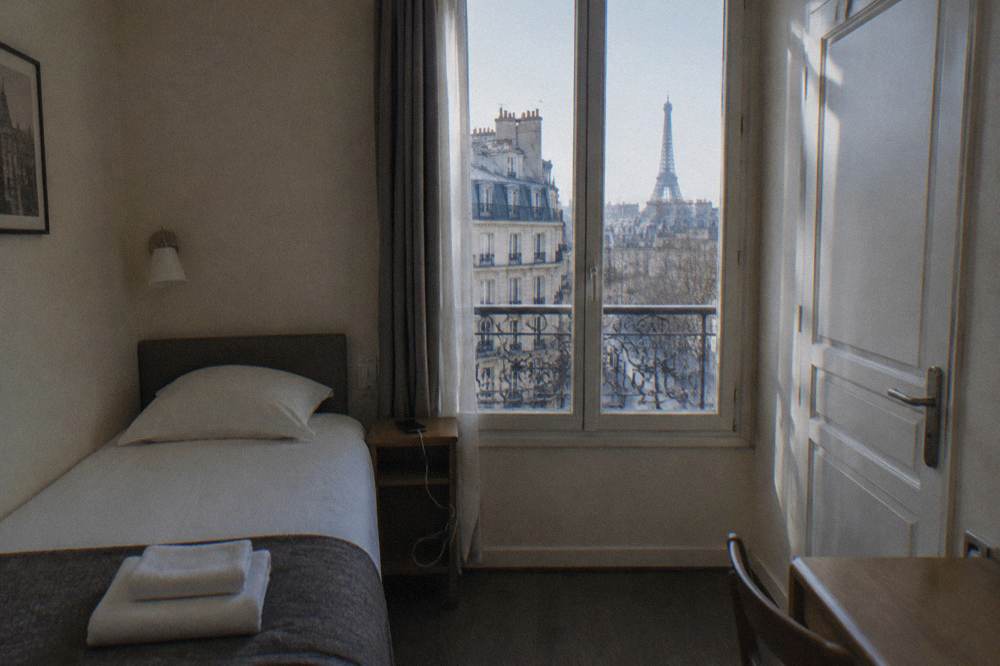
The evening before, not the day itself, is the smart check-in moment. By then tomorrow's demand is mostly visible, properties have adjusted, and you still have hours to rebook rather than minutes. A same-day check at noon leaves you negotiating from weakness with luggage in your hand. Cheap Hotels In Paris exists because a little planning reliably beats that position, and because the cheapest bed is rarely the one you find at midnight.
One refinement is worth adding: check the area, not just the property. If every budget property in your target arrondissement is showing high rates the evening before, the market is tight and your refundable booking is worth keeping. If the whole area has softened, that is the moment to rebook, and possibly to upgrade your choice of neighbourhood rather than only your price. The same evening check that saves five euros on a room can occasionally save thirty by moving one arrondissement over, a mechanic our guide to the cheapest arrondissements ranked by price makes concrete.
For travellers weighing this against the other classic timing question, our piece on what time hotels actually drop their prices covers the clock-side mechanics, and our hostels-versus-hotels comparison at whether a hostel is cheaper than a hotel handles the bed-type side.
If your dates fall in the expensive half of the year, stop reading about tactics and start reading about areas: the price differences between arrondissements are larger than any same-day discount you will ever see.
Common Questions About Booking Paris Hotels On The Day
Do hotel prices go down if you book on the day?
Sometimes, in Paris. A same-day discount requires unsold inventory, and with July 2026 occupancy at 85.1 percent the city does not often have it. The tactic works best for solo travellers taking dorm beds on quiet weekdays in the low season, and worst for couples and families in the high season.
What time of day do hotel prices drop?
Genuine markdowns usually appear in the evening, once a property knows how many rooms will go empty. Checking the evening before arrival, while you still hold a refundable booking, beats checking on the day itself.
Is it cheaper to walk into a Paris hotel without a booking?
Rarely at the budget end. Budget properties fill first, so a walk-in guest in a busy month is choosing among the rooms nobody else wanted, often at higher rates and in outer areas, plus tourist tax on top.
Does the Paris tourist tax change if I book late?
No. The tax is charged per adult per night at check-in regardless of when you book: EUR 2.60 in hostels and 1-star hotels, EUR 3.25 in 2-star and EUR 5.53 in 3-star properties. Booking tactics do not affect it.
Are hostels easier to book last minute than hotels?
Yes, generally. A hostel sells many dorm beds a night, which makes its inventory more liquid, so a bed is more likely to be available, and sometimes cheaper, on the day than a private double room.