Best Budget Hotels In Paris By Price Band
Budget hotel pricing in Paris moves in bands, and the band you pick decides your arrondissement more than any review score does. Here is what each band buys, where it clusters, and what the tourist tax adds per adult.
Short answer
Budget hotels in Paris fall into three working bands: under EUR 80 per room, EUR 80 to 99 per room, and EUR 100 and over per room, always per double room and before the tourist tax. The citywide average room price is far higher, around EUR 176.8, so anything under EUR 100 is genuinely below the Paris market rate.
Paris hotel pricing is easier to read in bands than in averages. The citywide average room price across all hotel categories stood at EUR 176.8 with occupancy at 74.4 percent in the February 2026 hotel observatory table, and by April 2026 the monthly average had climbed to EUR 217.5 at 83.6 percent occupancy. Those are all-category averages, palaces included, which means a double room under EUR 100 is not a normal Paris price. It is a price you get by choosing the right band and the right arrondissement on purpose. This guide sorts budget hotels in Paris into three nightly bands, under EUR 80, EUR 80 to 99, and EUR 100 and over, and shows what each band actually buys. One rule holds throughout: a hotel price is per room for two people, not per person, unlike a hostel bed which is always priced per bed. If you have your heart set on waking up within walking distance of the tower itself, our guide to budget hotels near the Eiffel Tower applies these same bands street by street.
If hostels are also on your list, the same site covers cheap hostels by budget and budget hotels near Gare du Nord, which overlap with the lower bands here.
How Much Does A Budget Hotel Room In Paris Cost Per Night?
A budget double room in Paris runs in three bands: under EUR 80 per room per night, EUR 80 to 99, and EUR 100 and over, always for the room and usually for two people. Below EUR 100 you are paying less than the citywide average room rate, which was EUR 176.8 across all categories in February 2026. Star class mostly tracks the band: 2-star hotels dominate the lower bands, 3-star hotels the upper one. If your trip centres on the parks rather than the city itself, our guide to budget hotels near Disneyland Paris applies the same band logic to that side of the region.
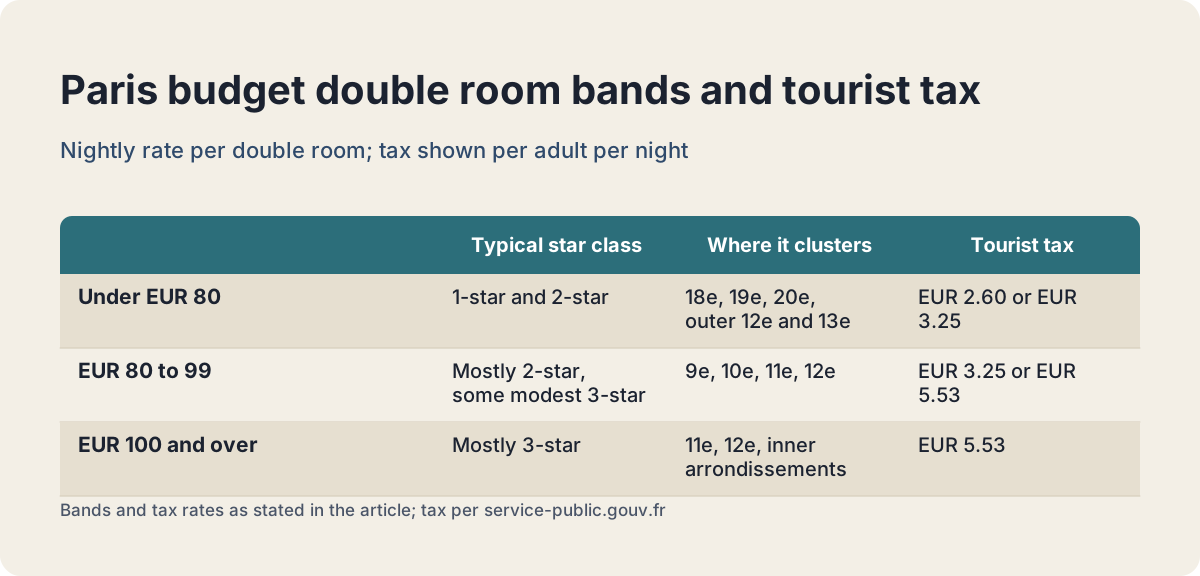
The bands are not marketing invention, they fall out of how Paris hotel stock is actually distributed. The 20e and 18e arrondissements, plus the outer parts of the 11e, 12e and 13e, hold most of the 1- and 2-star stock, and that is where the sub-EUR 80 room survives. The 9e, 10e and the inner 11e hold a thicker layer of 2- and 3-star hotels, and that is the natural home of the EUR 80 to 99 band. The EUR 100 and over band spreads wider, because a renovated 3-star near a metro hub in the 11e or 12e can clear the EUR 100 line on ordinary weekdays without being anything but a well-kept budget hotel. If you would rather trade the arrondissement map for a bed close to the terminals, the guide to cheap hotels near Charles de Gaulle covers what that trade costs you in character.
| Nightly band (per double room) | Typical star class | Where it clusters |
|---|---|---|
| Under EUR 80 | 1-star and 2-star | 18e, 19e, 20e, outer 12e and 13e |
| EUR 80 to 99 | Mostly 2-star, some modest 3-star | 9e, 10e, 11e, 12e |
| EUR 100 and over | Mostly 3-star | 11e, 12e, inner arrondissements |
Two costs sit on top of the room rate, and both belong in your band math. The first is the tourist tax, which is charged per adult per night, not per room, and which differs by star class: EUR 2.60 all-in at 1-star and hostel level, EUR 3.25 at 2-star, EUR 5.53 at 3-star, per the official service-public.gouv.fr taxe de séjour page. Two adults on a four-night stay at 3-star level therefore accrue well over twice the tax the same couple would pay at 1-star, before you have bought a coffee. The second is breakfast, which is often sold separately in exactly the hotels that fill the lower bands, so a room at the very bottom of the sub-EUR 80 band plus two hotel breakfasts can behave like a room a full band higher.
What Does The Under EUR 80 Band Get You?
The under EUR 80 band buys a real double room, usually in a 1- or 2-star hotel, in the outer arrondissements: think the 18e, 19e, 20e and the edges of the 12e and 13e. Rooms are small, lifts are rare above the fourth floor, and breakfast is typically an add-on. The tax is EUR 2.60 or EUR 3.25 per adult per night depending on star class, the cheapest of any band.
This band is where hybrid and social formats have been pushing traditional 1-star hotels hardest. Honotel inaugurated Glint, its first hybrid hotel brand, at 66 boulevard Barbes in the 18e: 50 rooms of which 42 are dorm-bed rooms and 8 are private doubles, with nights from EUR 40, per the trade press report on the opening. A private double from EUR 40 in the 18e redefines what the bottom band means, and it puts pressure on classic 1-star hotels a few streets away. For comparison, the City of Paris itself reported that Hostelle, the women-only hostel that opened in the 19e in June 2026, can start at EUR 18 per bed, per its own paris.fr visit piece. Beds and rooms are different products, but they now compete inside the same band.
What the band does not give you is space or centrality. A double at the lower end of this band in the 20e means a metro ride of twenty to thirty minutes to the Louvre, and the room itself will often be compact with a shower rather than a bathtub. That trade is worth it for stays of three nights or more where the money saved funds several days of metro tickets, which cost EUR 2.55 each at full fare on the 2026 Île-de-France Mobilités tariff. It is a poor trade for a one-night stopover, where you pay in transit time what you saved on the room.
The three properties above span the bands this guide covers, from compact cheaper rooms to the upper band, so the band labels and the live nightly rates can be compared side by side before anything is booked.
What Does The EUR 80 To 99 Band Get You?
The EUR 80 to 99 band is the sweet spot of Paris budget hotels: a 2-star double, sometimes a modest 3-star, in the 9e, 10e, 11e or 12e, often within a ten-minute walk of three or four metro lines. Rooms stay small but gain reliable ensuite bathrooms, and the tourist tax is EUR 3.25 per adult per night at 2-star, EUR 5.53 at 3-star.
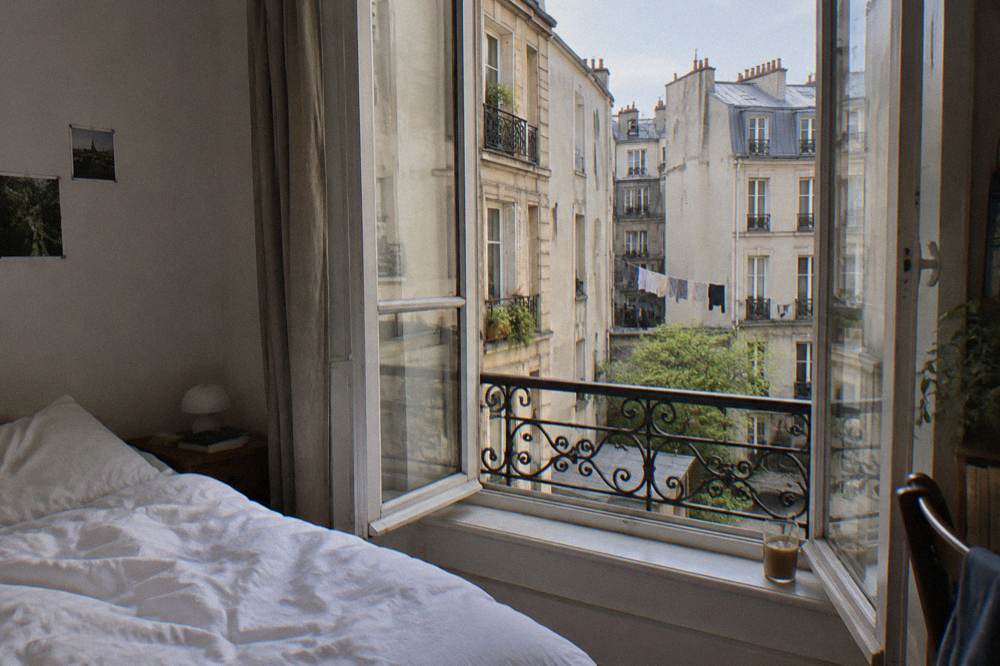
This is the band where the marginal euro buys location rather than square metres. Between EUR 80 and EUR 99 you move from the outer arrondissements into hotels that sit on real transport nodes, Gare du Nord and Gare de l'Est in the 10e, République in the 11e, Bercy and Gare de Lyon in the 12e. That matters more than it sounds in a city running heavy works: from October to December 2026 the RATP and SNCF are carrying out extensive network works with near-daily interruptions, especially weekends and late evenings, and the République stop on line 8 is closed until April 22, 2027. A hotel with three alternative lines in walking distance is worth the extra euros per night in exactly those months.
Hotel Madrigal, near the Pasteur metro station on the Left Bank, is a working example of the band: an independent budget hotel whose current nightly rate and room types are listed on the property page, in an area where the 6th, 14th and 15th arrondissements meet and where a 2-star double sits at the lower edge of the market. Because the rate is per room for two, a couple paying somewhere in the middle of this band is paying half that figure each, which is competitive with almost any bed-plus-privacy combination in the city. That per-room arithmetic is the single most useful mental shift when reading Paris hotel prices.
The band's one trap is the "standard" room label. In the EUR 80 to 99 range, a standard double can vary meaningfully in size, and in Paris attic and ground-floor rooms trade at the same headline price with very different noise and light. The property page room descriptions are the only reliable guide here, because photos flatter every band equally.
What Does The EUR 100 And Over Band Get You?
Above EUR 100 a night you are mostly buying a renovated 3-star double, a larger room, or a location in the inner arrondissements, and often all three. The tourist tax is EUR 5.53 per adult per night at 3-star. This band is still "budget" by Paris standards, since the citywide average room price was EUR 217.5 in April 2026, more than double the band's floor.
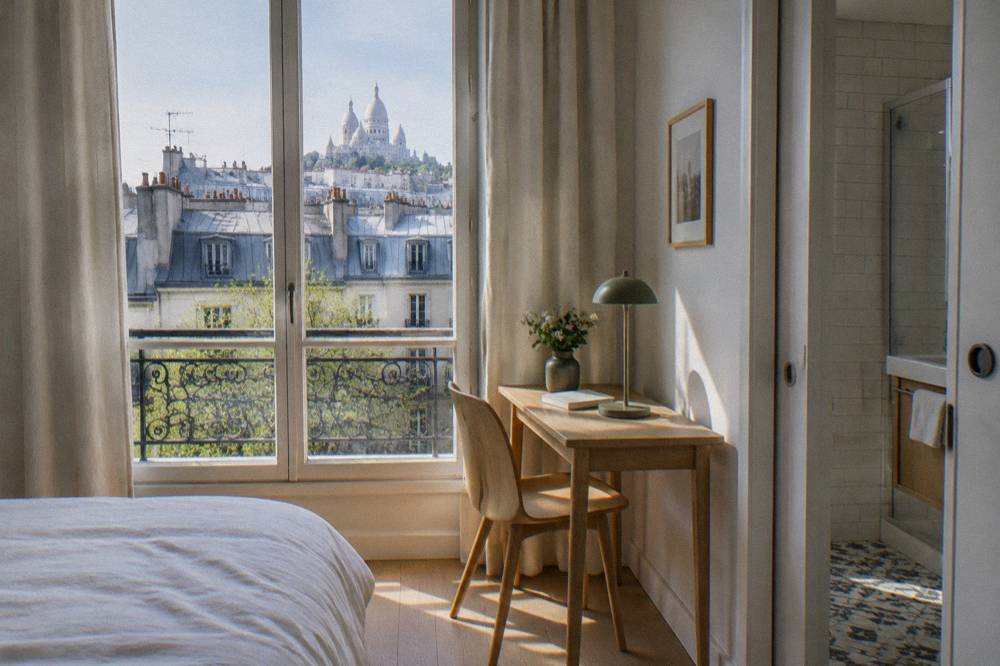
The upper band is where renovation cycles show. Extendam's acquisition of the ibis Paris Père Lachaise, a 3-star hotel with 31 rooms in the 11th arrondissement, entirely renovated in 2023 with its facade redone in 2025, per the buyer's own announcement, is the pattern: investors buy small 3-star properties, refresh them, and reprice them into the EUR 100-plus band. You pay for the renovation in the rate, but you get soundproofed windows, working air conditioning and a bathroom that was fitted this decade, three things the sub-EUR 80 band only sometimes delivers.
Hôtel le 209 Paris Bercy, a budget hotel that genuinely belongs to this band, sits in this conversation: its nightly rate, rating and room types are on the live listing rather than printed here, and the free-cancellation terms are worth checking before you commit, because flexible rates in this band often cost only a few euros more than non-refundable ones. Hotel Le 209 Paris Bercy, in the Bercy district of the 12e, is another upper-band option, with its current rate and review figures on its property page. Both are per-room properties, so a couple in this band pays roughly half the per-person rate the headline suggests, which still undercuts the citywide average by a wide margin. The wider set of guides lives on Cheap Hotels In Paris.
The honest question for this band is whether the money is better spent on nights. The gap between a mid-band EUR 80 to 99 room and a room near the top of the upper band, multiplied across four nights and two adults' worth of tax, easily clears the cost of a couple of meals and museum entries at Paris prices. If the cheaper room is genuinely reachable by metro, the lower band often wins the trip-level arithmetic, and the earlier per-room maths shows why: every euro of room rate is split across two people, but every euro of tax is not.
Which Arrondissements Cluster In Which Band?
The under EUR 80 band clusters in the 18e, 19e and 20e, the EUR 80 to 99 band in the 9e, 10e, 11e and 12e, and the EUR 100 and over band spreads from the 11e and 12e into the inner arrondissements. Location, not star class, is what moves a room between bands, and the same room can cross a band boundary purely by changing arrondissement.
The clustering follows the building stock. The outer arrondissements kept their small 1- and 2-star hotels because land values did not force redevelopment, and new hybrid supply reinforces the pattern: Glint opened on boulevard Barbes in the 18e with privates from EUR 40, and Hostelle in the 19e with beds from EUR 18, both reported above. The 11e is the pivot arrondissement: it holds 1-star survivors near Père Lachaise, an 80s-band core around Oberkampf and Parmentier, and renovated 3-stars like the ibis Paris Père Lachaise in the upper band, sometimes within a few hundred metres of each other.
| Band | Typical arrondissements | Typical star class | Tourist tax per adult/night |
|---|---|---|---|
| Under EUR 80 | 18e, 19e, 20e, outer 12e and 13e | 1-star and 2-star | EUR 2.60 to EUR 3.25 |
| EUR 80 to 99 | 9e, 10e, 11e, 12e | Mostly 2-star | EUR 3.25 |
| EUR 100 and over | 11e, 12e, inner arrondissements | Mostly 3-star | EUR 5.53 |
Note what the table does not say: that any specific hotel is always in its band. Paris rates move with demand, and the same 2-star double can sit at the bottom of its band in February and a full band higher during a trade fair. The band a hotel lives in most nights is a property fact; the band it sits in on your dates is a live-listing fact, which is why every recommendation here points at the current rate rather than a frozen number.
How Does The Tourist Tax Change The Band Math?
The tourist tax is charged per adult per night, not per room, and in 2026 it totals EUR 2.60 at 1-star and hostel level, EUR 3.25 at 2-star and EUR 5.53 at 3-star, levy included. For two adults staying four nights, that is EUR 20.80, EUR 26.00 or EUR 44.24 added to the room bill depending on the band you booked.
The figures come from the official service-public.gouv.fr tariff page, which folds in the 10 percent departmental, 15 percent regional and 200 percent Île-de-France Mobilités levies into the totals above. Two consequences follow for band shopping. First, the tax is flat per star class, so it weighs heaviest on the cheapest rooms: on the cheapest singles and doubles, the per-adult tax is close to a tenth of the nightly rate once both adults are counted. Second, an unclassified property is taxed differently, at 5 percent of the pre-tax per-person nightly cost with a cap of EUR 15.93, so a cheap unclassified room can carry a smaller tax than its 3-star neighbour.
| Star class | All-in tax per adult per night | Two adults, four nights |
|---|---|---|
| 1-star, hostels, guesthouses | EUR 2.60 | EUR 20.80 |
| 2-star | EUR 3.25 | EUR 26.00 |
| 3-star | EUR 5.53 | EUR 44.24 |
| Unclassified | 5% of cost per person, cap EUR 15.93 | Varies with the room rate |
Only adults pay, and the tax is collected at the property during the stay, not at the moment of booking, so the price you see on a listing may not be the price you settle at checkout. Budget for it as a separate line, especially in the upper band where it visibly lifts the per-night cost of a room for two.
Is It Better To Book The Cheapest Band Or A Higher One?
Book the cheapest band that meets three tests: a metro station within a ten-minute walk, ensuite facilities stated on the property page, and a cancellation option. If any test fails, move up one band rather than two, because the first step up buys the biggest jump in comfort and location for the smallest extra euros.
The decision is a trip-length decision as much as a budget one. For one or two nights, a sub-EUR 80 room in the 20e costs you an extra forty minutes of transit on arrival and departure days, which on a short trip is a real share of your time. For five nights, the cumulative gap between the bottom band and the middle one funds transport and a couple of meals. This site's month-by-month price guide covers when those bands dip, and the comparison of hotels against apartments covers the cases where a different property type beats every band.
Hotel Le 209 Paris Bercy, in the 12e near Bercy village and the Gare de Lyon corridor, is a useful reference point at the decision stage: its nightly rate and review figures sit on the property page, and its location, on a direct line from Gare de Lyon and within walking distance of Bercy park, means the transport test passes by construction. Whenever a hotel in any band sits directly on a main line from your arrival station, the effective cost of the cheaper outer bands rises, because you no longer need their metro connectivity.
Whichever band wins, book it with the cancellation option and recheck the rate a week before travel. Paris occupancy ran at 85.1 percent in July 2026, up 1.4 percent year on year, and in a market that tight the sub-EUR 100 rooms repriced last. A cancellation-safe booking in the EUR 80 to 99 band beats a non-refundable room at the very bottom of the market in the wrong arrondissement more often than not.
Common Questions About Budget Hotels In Paris By Price Band
How much is a budget hotel in Paris per night?
Budget hotel doubles in Paris fall into three bands: under EUR 80, EUR 80 to 99, and EUR 100 and over per room per night, always for the room and usually for two people. The all-category average Paris room price was EUR 217.5 in April 2026, so even the top budget band is well below the market rate.
Is a hotel price in Paris per room or per person?
A hotel price is per room for two people, not per person. A hostel price, by contrast, is always per bed. This is why a mid-band hotel double works out at half the headline rate for each person in a couple, which is competitive with a private hostel room in the same band.
Which Paris arrondissements have the cheapest hotels?
The under EUR 80 band clusters in the 18e, 19e and 20e, with outer parts of the 12e and 13e close behind. The EUR 80 to 99 band clusters in the 9e, 10e, 11e and 12e. The EUR 100 and over band spreads from the 11e and 12e inward.
How much is the tourist tax on a budget hotel in Paris?
In 2026 the all-in tourist tax is EUR 2.60 per adult per night at 1-star and hostel level, EUR 3.25 at 2-star and EUR 5.53 at 3-star. It is charged per adult, not per room, and collected at the property during the stay rather than at booking.
What is the cheapest hotel format in Paris right now?
Hybrid hotels are pushing the bottom band down: Glint, opened at 66 boulevard Barbes in the 18e, has private doubles from EUR 40 alongside 42 dorm-bed rooms. Traditional 1-star doubles under EUR 80 remain the cheapest conventional hotel product.
Should I book a cheaper room further out or pay more centrally?
For stays of three nights or more, the cheaper outer band usually wins on total trip cost. For one or two nights, transit time on arrival and departure days eats the savings, and the EUR 80 to 99 band near a major station is usually the better buy.