Where To Stay Just Outside Of Paris?
The case for sleeping at the edge of Paris instead of the centre: edge properties, metro ticket costs, tourist tax and line works, with real figures.
The average Paris hotel room cost EUR 217.5 a night in April 2026 across all categories, which is a figure from the UMIH hotel observatory's monthly table, and it is not a number a budget traveller wants to meet every night of a week. There is a way around it that does not involve leaving the region or committing to a long commute from a distant suburb: sleep at the edge of Paris itself, at one of the portes, where the city's own budget properties cluster and the metro still runs under the street. This article works through what that trade costs and when it pays. And if your train pulls in at Gare du Nord, our guide to getting from that station to your hotel covers the metro, taxis, and RER disruptions you might meet along the way.
The short version: an edge location trades ten to twenty extra minutes on the metro for a materially cheaper room, and the ticket price does not change with distance. A single Metro-Train-RER ticket is EUR 2.55 full fare wherever you board inside Paris. The tourist tax does not change either, because the portes are inside the city, so the same city rates apply. What changes is the room rate, and on the edge the drop can be significant.
For a first look at three edge-of-city options that sit right on major metro and tram junctions, this selection is a reasonable starting point:
Where To Stay Just Outside Of Paris?
The three most practical spots to sleep at the edge of Paris are Porte de Clignancourt in the north, Nation and Porte de Vincennes in the east, and the Père Lachaise side of the 11th. Each sits directly on a metro junction that runs into the centre, each still counts as Paris for the tourist tax, and each carries room rates well below the city-wide average of EUR 217.5 a night recorded in April 2026. The trade is measured in metro minutes, not in money once you are on the platform.
Think of Paris as a circle with a wall of portes around it. Historically these were the toll gates, and today they are where the metro termini, the tram lines and the cheapest legitimate hotel rooms inside the city limits tend to sit. Porte de Clignancourt serves the 18th arrondissement at the top of the city, with the flea market at Les Puces just beyond the boundary. Nation in the 12th is one of the largest metro interchanges in Paris, and Porte de Vincennes in the 12th anchors the eastern end of line 1. The Père Lachaise side of the 11th sits one stop further in, and it is where the ibis Paris Père Lachaise operates, a 3-star establishment with 31 rooms that was entirely renovated in 2023 and had its facade redone in 2025 before its 2026 acquisition by Extendam was announced in the trade press.
The reason the edge is cheaper is ordinary economics. Central Paris rooms face demand from every visitor who wants to walk to the Louvre, and the July 2026 occupancy rate across Paris hotels was 85.1 percent, up 1.4 percent year on year according to the Paris Je t'aime barometer. At those occupancy levels, central properties do not need to discount. Rooms at the portes serve a mix of locals, business guests on per-diem rates and price-aware visitors, and the nightly rate reflects that. The summer of 2026 brought 13.3 million tourists to Paris and Île-de-France between June and August, a 3 percent increase on 2025, with their spending reaching 7 billion euros, so the pressure on central beds is not easing.
One distinction matters before anything else: the edge of Paris is not the suburbs. Montreuil, Saint-Denis, Boulogne and Vincennes the commune are outside the city, in other municipalities with their own tourist tax rates and their own commuting math. This article stays inside the boundary, at the portes themselves, because that is where you keep the standard Paris metro ticket, the Paris tourist tax grid and the properties this site covers. If you want the genuinely suburban comparison, the guide on is it cheaper to stay outside Paris takes that question up in full.
Which Edge Properties Actually Deliver The Savings?
Kyriad Paris 18 Porte de Clignancourt, ibis Paris Nation Davout and MEININGER Paris Porte de Vincennes are the three edge properties worth pricing first, all sitting at portes on major lines. Each has its nightly rate and room types on the live listing rather than in a fixed price table. A fourth option, the ibis Paris Père Lachaise, is a 3-star, 31-room property in the 11th one ring further in. Together the four cover hotel, chain hotel, hybrid hostel and renovated mid-range formats.
The northern edge option is Kyriad Paris 18 Porte de Clignancourt, located at the Porte de Clignancourt junction where metro line 4 and tram T3b meet. That junction matters more than the property itself: line 4 runs straight down through Châtelet and the Île de la Cité to the southern edge of the city, so the centre is one seat, no changes, for the price of a standard ticket. For a worked comparison of room rates by price band, see budget hotels in Paris by price band, which sets the edge properties against their central equivalents.
On the eastern side, ibis Paris Nation Davout sits near the Nation interchange in the 20th, where lines 1, 2, 6 and the RER A cross. Nation is roughly ten minutes from Châtelet on line 1. MEININGER Paris Porte de Vincennes occupies the far eastern end of line 1 at Porte de Vincennes, with tram T3a on the surface, and it sells dorm beds, listed from €20 per person. The MEININGER group's own 2025 insights put the average budget of French travellers for affordable city breaks at EUR 38.3 per night per person, which tells you roughly what kind of nightly figure these properties are built around.
Should you book the edge now or wait?
A property one street inside the boundary behaves like a Paris property in every administrative sense. A property one street outside it does not. That single street decides whether your tourist tax is set by the Paris grid and whether your metro trip is a standard city ticket, so when a listing says "Paris" in its name, check the arrondissement or the commune before assuming the edge math applies.
How Much Does The Metro Ticket Cost From The Edge?
A single Metro-Train-RER ticket inside Paris costs EUR 2.55 at full fare and EUR 1.30 at reduced fare, and that price is the same whether you board at Porte de Clignancourt, Porte de Vincennes or Châtelet itself. There is no distance charge inside the city, no zone premium at the portes, and no surcharge for boarding at a terminus. A commuter travelling in daily from the edge spends EUR 5.10 a day on two single tickets, or less with a carnet or pass.
The full 2026 fare lines published by Île-de-France Mobilités, the regional transport authority, look like this for the trips an edge-based visitor actually takes:
| Ticket | Full fare | Reduced fare |
|---|---|---|
| Single Metro-Train-RER ticket | EUR 2.55 | EUR 1.30 |
| Ticket Paris Région to Airports (CDG or Orly) | EUR 14.00 | EUR 7.00 |
| Orlyval ticket | EUR 14.00 | EUR 7.00 |
Two things follow from that table. First, the airport ticket costs the same from an edge location as from the centre, so staying at a porte does not penalise your arrival or departure day. The Ticket Paris Région to Airports, which replaced the old separate Orly and CDG airport tickets at the start of 2026, allows connections for two hours from the first validation without exiting the network, per the official fare page at Île-de-France Mobilités. Second, because there is no distance pricing inside the city, the "extra cost of commuting in" that people fear from an edge stay is really just the flat ticket you would have bought anyway from a central hotel for any trip beyond walking range.
Put a weekly number on it. A visitor staying five nights at the edge and taking four metro trips a day spends a modest transport total across the stay at full single-fare rates, since every trip is the same flat EUR 2.55. If the edge room is even EUR 20 a night cheaper than the central alternative, that transport spend is fully absorbed by day three. That is the entire calculation, and it is why the edge question reduces to one line: how big is the gap between the edge room rate and the central room rate on your dates?
There is a caveat on late evenings at the northern edge specifically. RER B, which serves Charles de Gaulle airport, has been running early closures tied to works lasting until December 2026, with trains stopping at 22:45 on most nights through the end of September per press reports. If your edge base relies on a line under works, check the running times for your dates rather than assuming a last train around 1 a.m., which is the normal Paris pattern.
Does The Tourist Tax Change At The Edge?
No, because the portes are inside Paris, the Paris tourist tax grid applies unchanged: EUR 2.60 per adult per night at hostels and 1-star properties, EUR 3.25 at 2-star, and EUR 5.53 at 3-star, all including the regional levies. The tax is per adult per night, never per room, children are exempt, and it is collected at the property during the stay rather than at booking. Those rates took effect on 1 January 2026.
The full grid as published by the official service-public page on the 2026 Paris evolution of the taxe de séjour:
| Category | All-in tax per adult per night |
|---|---|
| Hostels and 1-star (auberges collectives, 1 étoile) | EUR 2.60 |
| 2-star | EUR 3.25 |
| 3-star | EUR 5.53 |
| 4-star | EUR 8.45 |
| Unclassified or awaiting classification | 5% of nightly cost, capped at EUR 15.93 |
The all-in figures include the departmental 10 percent and regional 15 percent additions plus the Île-de-France Mobilités levy that has applied since 2025 and amounts to 200 percent of the base tax, which is why the numbers look higher than the base rates people remember from a few years ago. The official detail is on service-public.gouv.fr. For a fuller walk-through of what the tax covers and who pays it, the guide to Paris tourist tax for hotels and hostels does the whole job.
The unclassified row matters at the edge more than in the centre, because smaller independent properties and apartment-style stays at the portes are more likely to be unclassified than a chain hotel. An unclassified property charges 5 percent of the pre-tax nightly cost per person, plus additional taxes, capped at EUR 15.93. Because the charge is a percentage, it rises with the room rate: on a very cheap edge room the percentage can land below the 2-star flat rate, but on an expensive one it climbs toward the cap, and an unclassified "cheap" room can then carry a higher tax than a classified 3-star property. Check the classification on the listing before comparing headline rates.
Cross the boundary and this section stops applying. A room in Saint-Denis or Montreuil is in a different commune with its own rates, and the comparison stops being a Paris tax question. The whole point of staying at a porte is that nothing administrative changes, only the room rate does.
Are Line Works A Reason To Avoid A Particular Edge?
Treat October to December 2026 as a works season, not a reason to avoid the edge altogether: RATP and SNCF are running extensive works across Île-de-France in that window, with near-daily interruptions on metro, RER and Transilien lines, especially on weekends and late evenings. Two named closures matter for edge planning: Saint-Michel on line 4 is closed until 19 December 2026, and République on line 8 until 22 April 2027. Neither is a porte station, but both sit on lines edge travellers use.
Line 4 is the backbone of a Porte de Clignancourt base, running from the northern porte straight through Châtelet to the southern edge. The Saint-Michel closure does not sever the line, it removes one central stop, so a Clignancourt guest travelling to the Latin Quarter gets off one stop early at Cité or continues to Odéon. That is an inconvenience measured in a few hundred metres of walking, not a broken commute. Line 8's République closure runs longer, into April 2027, and matters for anyone whose edge base feeds through that interchange, particularly on the eastern side.
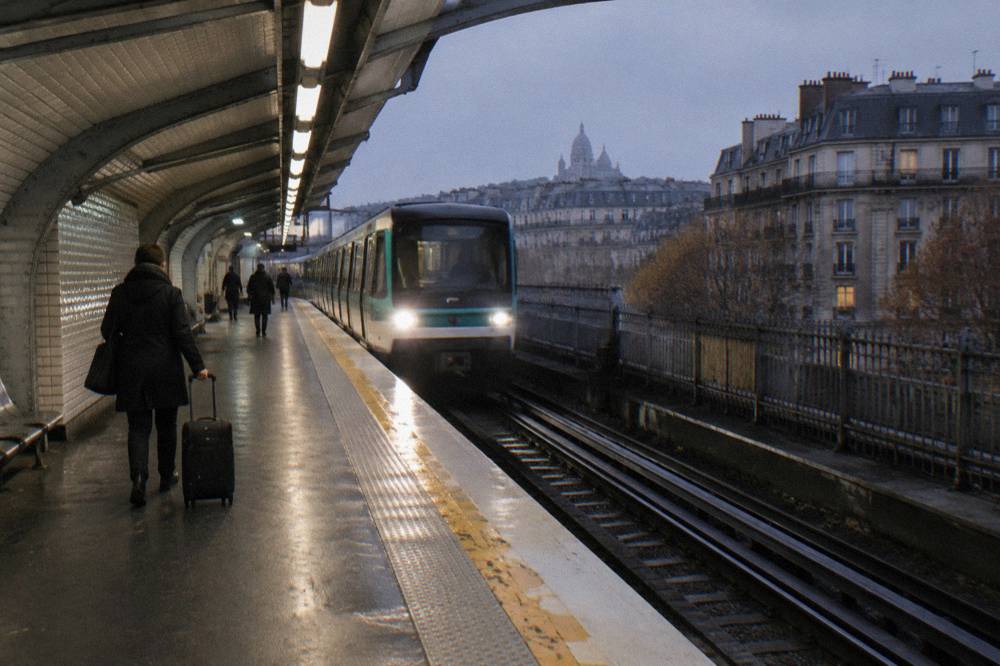
The practical habit is to check the specific line your property depends on for your exact dates. The pattern of the current works season is interruptions concentrated on weekends and late evenings, which means a weekday city break may notice almost nothing while a Saturday-to-Tuesday trip could hit adapted timetables or bus replacements. An edge stay amplifies works disruption slightly, for the obvious reason that you take the metro more often than someone who walks out of a central hotel straight into the sights.
Set against that, the security picture on the network has been reinforced: the RATP inaugurated a new security headquarters on 3 July 2026 that centralises surveillance of the network using 15,000 cameras, and since 30 March 2026 the internal security services of SNCF and RATP have had expanded powers in stations and their immediate vicinity, per the official service-public notice. Late-night rides in from a porte are monitored transport, not an empty ride through the dark.
Hostel Bed Or Edge Hotel: Which Wins On Price?
A dorm bed at the very edge of Paris starts lower than any hotel room can, with Hostelle in the 19th near the Canal de l'Ourcq advertising beds from EUR 18 a night, while the hybrid Glint at 66 boulevard Barbès in the 18th opened with dorm-bed rooms from EUR 40 and private doubles at the top of that scale. An edge hotel room like the Kyriad at Porte de Clignancourt carries its rate on the live listing, but hotel formats at the portes often undercut their central equivalents, with from-prices as low as $20 at Porte de Vincennes.
The two new properties are genuinely informative about where the Paris budget market is heading. Hostelle, which the City of Paris presents as the first women-only hostel in Paris, opened in June 2026 in the 19th, with dorm rooms of 4 to 18 beds and prices starting at EUR 18 a night depending on room size. Glint, the hybrid brand inaugurated by Honotel on 22 September 2026 at 66 boulevard Barbes in the 18th, mixes 50 rooms including 42 dorm-bed rooms and 8 private doubles, from EUR 40 a night; the building had actually been operating since the end of May 2026 after a five-month closure for works, with September marking the official inauguration. Both sit at or beyond the northern edge, and both price in the band that makes the edge argument by existing. Families weighing the same tradeoff between price and position should read our breakdown of the most practical Paris districts for families on a budget, which applies the same nightly-rate logic to apartments with kitchens and lifts.
Run the per-person arithmetic that decides it. Two travellers comparing a EUR 40 dorm bed each at an edge hybrid against a EUR 90 edge double room pay EUR 80 either way, so the hotel wins on privacy at a par price, and the hostel wins only when beds fall well below half the room rate. Change the party to three or four and the dorm math collapses: four beds at EUR 40 is EUR 160 against one family or quad room, and the room almost always wins. The hostel-vs-hotel trade is really a party-size question, and the blog piece on whether a hostel is cheaper than a hotel works it through with the same arithmetic.
At the eastern edge, MEININGER Paris Porte de Vincennes makes the decision easy. It lists dorm beds under one roof, a straightforward fit for a group that wants a bed each and nothing more to debate. Its rate is on the live listing; the MEININGER brand's published average budget figure for French city-break travellers, EUR 38.3 per person per night, gives a fair sense of the band it prices into.
Is An Edge Base Worth It On A Short Trip?
As a rough rule of thumb, on stays of three nights or more an edge base usually wins once the room rate gap runs past about EUR 15 a night, because transport from a porte costs the same EUR 2.55 ticket you would buy anyway from a central hotel. On a one-night trip it rarely makes sense: you pay the same airport ticket, the same tourist tax, and you trade walking distance for two extra metro legs on a tight schedule. Two nights is the genuine borderline, and the deciding figure is the room rate difference on your dates. If your trip runs a full week rather than just a couple of nights, our guide to what a week of lodging in Paris really costs shows how these same tradeoffs play out across a longer stay.
The reason short trips favour the centre is that the edge's savings are per-night while its costs are per-trip-temptation. A visitor with one full day in Paris wants to be walking-distance from something famous at 7 a.m. and 10 p.m., and no EUR 20 saving repairs a 25-minute ride at the end of an exhausted day. A visitor with five nights has four or five of those rides spread across a stay, and the accumulated room savings buy a very good dinner. Time the decision to the calendar too: shoulder-month rates at the portes move more than central rates do, and the month-by-month guide to when Paris is cheapest maps the dips.
Event weeks flip the whole calculation, and the 2026-2027 calendar has several. Paris Games Week runs 22 to 25 October 2026 at Paris Expo Porte de Versailles, the Fête des Vendanges de Montmartre takes the 18th from 7 to 11 October 2026, and the Salon International de l'Agriculture fills Porte de Versailles from 27 February to 7 March 2027. During those windows central rates spike first and hardest, and an edge property near a different porte becomes not the budget compromise but the rational booking. A Montmartre-adjacent edge base during the Vendanges festival, for instance, puts you inside the crowds for free and one metro stop from a quieter bed.
One booking habit carries over from Cheap Hotels In Paris generally: price the edge and the central option on your real dates, on the same listing, before deciding. Averages like the EUR 217.5 city-wide figure set the backdrop, but your specific week decides the gap, and the gap decides everything.
Before the closing questions, here again are the three edge properties this article has weighed, collected in one place for a final price check:
Common Questions About Staying Just Outside Paris
Where To Stay Just Outside Of Paris?
Stay at a porte inside the city boundary: Porte de Clignancourt in the 18th, Nation or Porte de Vincennes in the 12th, or the Père Lachaise side of the 11th. Each sits on a direct metro line into the centre, keeps the standard EUR 2.55 city ticket and the Paris tourist tax grid, and carries room rates well below the April 2026 city-wide average of EUR 217.5 a night.
Is it cheaper to stay at the edge of Paris than in the centre?
Usually yes, by a margin that widens in high season. The metro ticket costs the same EUR 2.55 wherever you board in Paris, and the tourist tax is unchanged inside the boundary, so nearly the whole room-rate difference is pure saving. From about three nights onward, any nightly gap above roughly EUR 15 covers the transport and then some.
Do I pay more tourist tax at the edge of Paris?
No. The portes are inside Paris, so the city grid applies: EUR 2.60 per adult per night for hostels and 1-star properties, EUR 3.25 for 2-star and EUR 5.53 for 3-star, all including the regional levies. The tax is per adult, per night, collected at the property, and children are exempt.
Does the metro cost more from a porte like Clignancourt?
No. A single Metro-Train-RER ticket is EUR 2.55 full fare anywhere inside Paris, with no distance or zone charge. The airport ticket is EUR 14.00 full fare to either Charles de Gaulle or Orly and allows connections for two hours from first validation.
Are the edge areas safe at night?
The edge stations are monitored transport: the RATP's new security headquarters, inaugurated 3 July 2026, centralises 15,000 cameras across the network, and since 30 March 2026 SNCF and RATP security agents have had expanded powers in stations and their immediate vicinity. As anywhere in Paris, keep to lit main streets and mind pickpockets on crowded platforms.